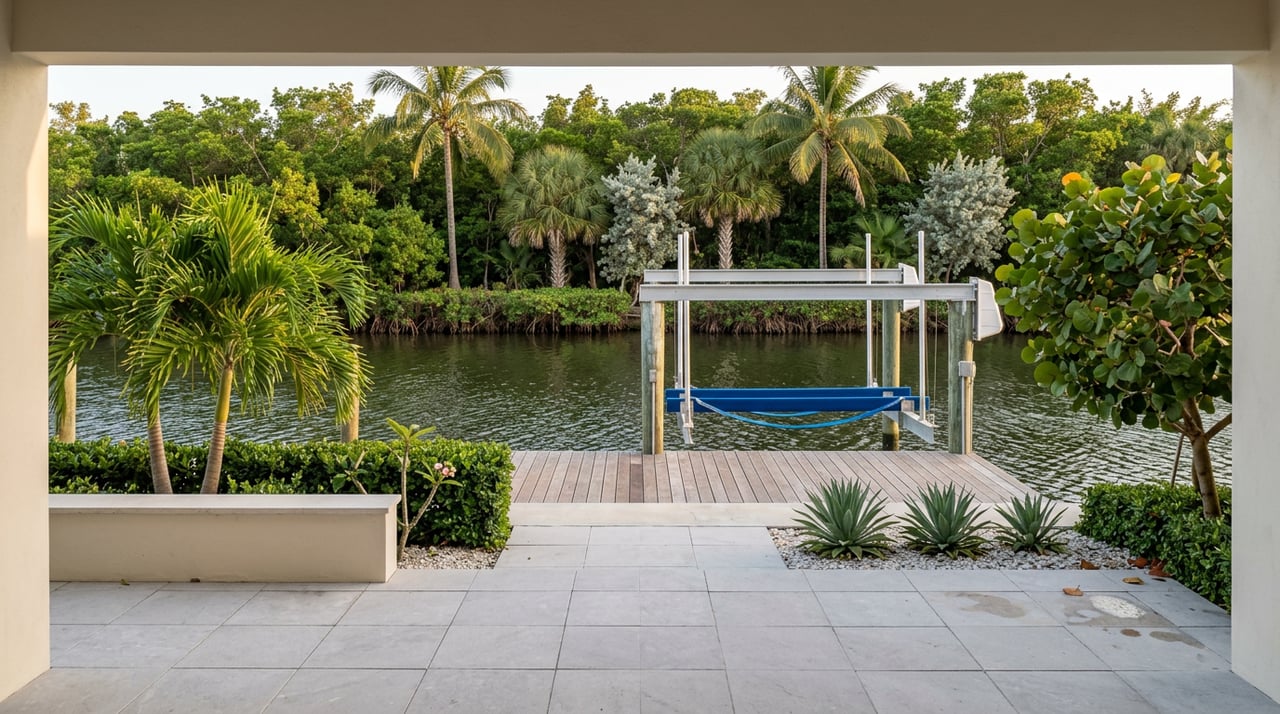
Two homes came across the desk last month with nearly identical MLS descriptions. Both sat in Royal Harbor. Both promised "direct, no-bridge access to the Gulf of Mexico through Gordon Pass." One could hold a 55-foot sport fisher with a tuna tower. The other could not comfortably keep the buyer's 34-foot center console at low tide.
The listing language did not lie. The physics did the rest.
That gap is the entire story of Royal Harbor as a mid-market Naples waterfront play. The neighborhood sells at a meaningful discount to Aqualane Shores and Port Royal, and the discount is not a bug in the market. It is priced dispersion inside a single label. Understanding which side of that dispersion a specific address falls on is what separates a good buy from a boat you cannot actually keep.
The Gordon Pass advantage is real, and it is narrower than buyers think
Naples has three passes to the Gulf. Gordon Pass and Doctors Pass carry no fixed bridges. Wiggins Pass, farther north, forces boaters south of Bluebill Avenue to clear roughly 19 feet at mean high water. That is the structural reason Royal Harbor, Aqualane Shores, and Port Royal command a premium: every canal drains east into Naples Bay and south through Gordon Pass without a single overhead concrete span in the way.
Inside the no-bridge club, the field is smaller than the marketing suggests. In the Moorings and Coquina Sands, only specific streets share the advantage: sections of Mooring Line Drive, Bow Line Bend, Bow Line Drive, Windward Way, and Leeward Lane. Elsewhere in those neighborhoods, boaters route through Doctors Pass with vessel limits set by residential bridges. Vanderbilt Beach and the Conners canals cross under the Bluebill Avenue bridge on the way to Wiggins.
So the honest way to describe Royal Harbor is this: it is one of a small number of Naples enclaves where a serious boat can live at the back of the house and reach the Gulf without ducking anything. That is a real and defensible premium.
It is also where the shared story ends and the address-specific story begins.
The median price is hiding the actual product
Freshness first. In February 2026, Royal Harbor's median sale price sat at $2,401,750, up 17.2 percent year over year. By early June 2026, there were 35 active listings with an average of 146 days on market, an average of $1,661 per square foot, and a median list price of $3,950,000. Active inventory in Q2 2026 ran from roughly $1.8 million to just under $15 million.
That is a nine-figure spread inside a half-square-mile neighborhood of about 400 to 540 single-family homes. Compare that to the broader Naples market coming into 2026, where the November 2025 NABOR data showed a single-family median near $800,000 and a citywide luxury tier at $3 million and above with days-on-market often running past 120 and sometimes 200. Royal Harbor's numbers sit inside that luxury bucket, but the internal geometry of the spread is not about square footage or vintage. It is about water.
Two 3,500-square-foot homes on Marlin Drive can list six or seven million dollars apart because of what is behind them, not what is inside them. A buyer who anchors on the median walks into that spread blind.
The dock envelope is the product
The right way to underwrite a Royal Harbor home is to start with the boat and work backward. The neighborhood divides into two operating classes.
| Position | Typical vessel envelope | What to verify |
|---|---|---|
| Kingfish Road frontage and bayfront positions on Naples Bay | Yachts, sport fishers, sailboats with tall masts, larger cruisers | Wide, deep canals with turning room. Confirm mean low water depth and any air-draft limits from residential service drops. |
| Interior canals across Royal Harbor, Oyster Bay, and Golden Shores | Mid-size powerboats, center consoles, bay boats, cuddy cabins, roughly to 30 feet | Canal width, turning radius, and MLW depth vary block to block. Interior canals are excellent for a well-matched boat and punishing for an oversized one. |
Nearly every waterfront home carries a private dock, and current listings show lifts from 10,000 pounds up to 30,000 pounds. Those numbers matter more than a vague "boater's dream" line. A 30,000-pound lift on a canal that shoals to two feet at spring low tide is a very expensive planter.
Five items that price a Royal Harbor dock
- Mean low water depth at the dock face. Southwest Florida runs a modest tidal range of roughly one to two feet, which means an interior canal that reads three and a half feet at high tide can drop under two at the wrong moon phase. Have a marine surveyor sound it. Do not rely on the listing agent's summer photo.
- Canal width and turning basin. A 42-foot boat needs somewhere to swing. Kingfish Road and bayfront lots have that room. Cul-de-sac canals in the interior often do not.
- Overhead clearance from residential power drops. No fixed bridges does not mean unlimited air draft. Utility lines cross docks and canals across the neighborhood. Tall T-tops, hardtops, and any mast should be measured against the actual span, not the pass at the end of the trip.
- Seawall age, condition, and cap elevation. Look at the toe for undermining, at the wall for hairline separation, and at the cap for spalling. Post-storm flood-elevation codes have moved. A seawall built in the 1970s that has not been re-capped is a five- to seven-figure conversation.
- Lift capacity and dock utilities. Shore power, water, and lighting on older docks were not built for modern boats. If the boat you plan to keep is not on the dock at closing, the survey needs to confirm the lift can hold it and the electrical service can charge it.
Gordon Pass itself adds one more layer. Currents strengthen at strong ebb and flood, wave conditions can steepen at the pass mouth on an outgoing tide when Gulf swell is present, and shoaling migrates. Any buyer planning to run offshore regularly should build a trip pattern around NOAA charts and the U.S. Coast Guard Local Notice to Mariners rather than seller anecdotes.
Why Royal Harbor trades below Aqualane Shores and Port Royal
The three neighborhoods share Gordon Pass. They do not share everything else.
Port Royal offers the widest canals, the deepest water, and the largest turning basins in Naples. It sets the ceiling. Aqualane Shores runs slightly tighter canals with smaller average lot sizes, sitting a short walk from Third Street South. Royal Harbor delivers the same bridge-free access to the same pass, at an entry price that in 2026 starts under two million dollars for a home requiring renovation and runs to the mid-teens for a bayfront trophy.
The premium Aqualane Shores and Port Royal carry over Royal Harbor is not paying for the pass. It is paying for a guaranteed dock envelope and address prestige. Inside Royal Harbor, that envelope is available on the right block. The buyer's job is to know which block.
There are practical reasons to prefer Royal Harbor even when budget is not the constraint. HOA dues sit at roughly $50 a year, streets are maintained by the City of Naples, and there are no community amenities to underwrite. Owners build their own pools, their own outdoor rooms, and in a growing number of cases, whole-house generators with substantial fuel storage. Recent Sand Dollar Award recognitions in the neighborhood, including a 2025 Product Design of the Year for Single Family, reflect the depth of the tear-down and rebuild cycle that has been running since the late 1990s. New construction with delivery dates in late 2026 currently sits on the market alongside 1960s originals.
The lifestyle context earns its own line. Fifth Avenue South, Third Street South, and the Naples Pier are one to two miles away. The Bayshore Arts District, named "Southwest Florida's Coolest New District" by Gulfshore Life, sits directly to the east, with Celebration Park and Naples Botanical Gardens inside a short drive. Full-service marina infrastructure is close by at Hamilton Harbor Yacht Club, Naples Sailing and Yacht Club, Naples Bay Club, and the Naples City Dock. None of those addresses is the reason to buy a specific home in Royal Harbor. They are the reason the neighborhood as a whole prices where it does.
What the days-on-market number is telling sellers
The 146-day average DOM in June 2026 is not slow for the tier. It is normal for Naples luxury and consistent with the citywide pattern of $3 million-plus inventory sitting past 120 days into 2026. Sellers who priced against the 2022 frenzy are the ones sitting past 200. Well-prepared homes with clean seawalls, documented lift capacity, current elevation certificates, and dock utilities that meet current code are still trading inside 90 days at strong per-foot numbers. That is where pre-market project work carries a measurable payoff. A summer of seawall re-capping, a lift upgrade, and a dock rebuild ahead of listing can move a Royal Harbor home from the interior-canal comp set into the buyer-ready comp set.
FAQ
Can a Royal Harbor home hold a sailboat with a tall mast? On the right canal, yes. Bayfront positions and the widest Kingfish Road frontages have historically supported tall-mast sailboats. Interior canals generally cannot, and residential utility drops set a hard ceiling that is address-specific. Confirm both the water dimensions and the air-draft along the actual route to open water before writing an offer.
How does flood insurance play into a Royal Harbor purchase? Flood zone designation drives cost, and it is address-specific across the neighborhood. Buyers with federally backed mortgages in AE or VE zones will carry mandatory coverage. Even X-zone properties near the coast have seen claims in recent storm cycles. Pull the elevation certificate early and price the annual carry into the underwriting rather than treating it as a closing surprise.
Is a teardown still viable given current construction costs? Teardowns and lot assemblages continue in Royal Harbor, and 2025 and 2026 deliveries include several award-winning new builds. The math works when the lot geometry supports the vessel and the finished product lands in a bayfront or wide-canal comp set. It does not work as reliably on a narrow interior lot where the ceiling on resale is set by neighbors, not by the build quality.
Why buy Royal Harbor instead of Aqualane Shores? Entry price and lot generosity. Buyers who match the boat to the block can secure the same Gordon Pass advantage for two to five million dollars less than an equivalent Aqualane Shores address. Buyers who need the address itself as part of the trade should look south and west.
Royal Harbor rewards buyers who treat the dock as the product and the house as the finish. If a private consultation on a specific canal, seawall, or lot assemblage would be useful, Anthony Caraballo with The McCumber Group at Gulf Coast International Properties can walk the address, coordinate the marine survey, and provide private-market access to opportunities that never reach the MLS. Schedule a private consultation or request private-market access.