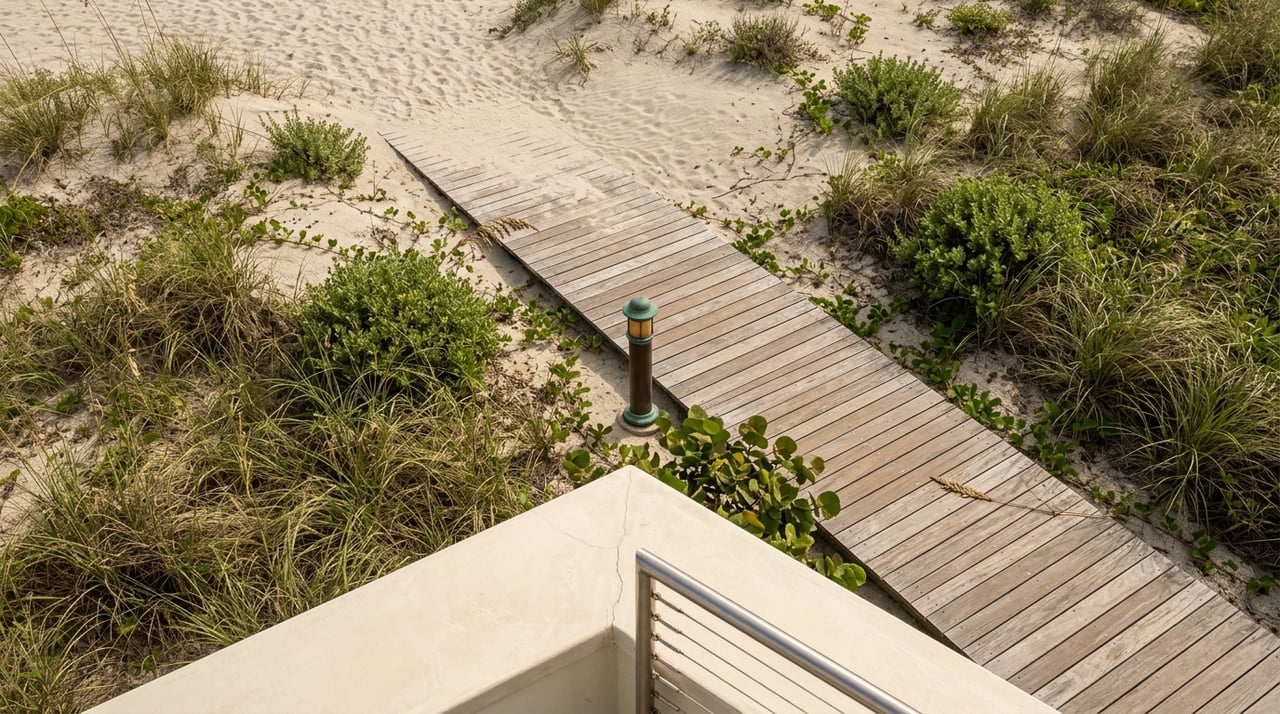
Walk the beachwalk from Horizon House north to LeParc on any given morning and you will notice something odd if you pay attention. The concrete changes texture in places. The lighting along one stretch glows warm and low, turtle-friendly bollards spaced evenly, while another stretch sits darker, waiting on fixtures that haven't arrived yet. Benches appear in clusters, then vanish for a few hundred feet, then reappear. Signage warning off bicycles and dogs looks freshly printed in one spot and absent in the next.
Most residents chalk this up to uneven maintenance, or assume the whole mile-plus is one continuous project moving at its own pace. It isn't. The Promenade, as longtime owners call it, is not a single amenity with a single timeline. It is five separately governed properties stitched together along the sand, each with its own board, its own budget, and its own recovery clock since Hurricane Ian tore through in 2022.
One Walk, Five Landlords
The beachwalk was built by the Lutgert Company in the early 1970s as part of the original master development along Gulf Shore Boulevard North, and it has never belonged to the City of Naples. Ownership sits with five separate condominium associations, known locally as the Commons, each responsible for the stretch of walk fronting its own buildings:
- Commons R, in front of Surfsedge
- Commons S, running from Gulfside up to La Mer
- Commons T/U
- Commons V
- Commons W, between the Vistas and LeParc
Each Commons has its own board of directors, appointed by the condominium properties that make up that segment. The Gulf Shore Association of Condominiums, known as GSAC, coordinates communication across the five boards and publishes the updates residents actually read, but GSAC does not own a foot of the walkway. That distinction matters more than it sounds. When one segment finishes lighting repairs months ahead of its neighbor, it is not a case of one board dragging its feet. It is five separate entities, each answering to its own unit owners and its own assessment schedule.
What Four Years of Storms Actually Cost
Hurricane Ian's 14-foot storm surge broke apart sections of concrete that had survived intact for more than fifty years. Hurricanes Milton and Helene added further damage in 2024, compounding repairs that were still underway. Because the walk is private property, none of the reconstruction came from public storm-recovery funds. It was paid for through assessments on the condominium owners themselves, and the total across all five Commons has run well over $15 million, covering not just the concrete but the dunes, plantings, irrigation, and lighting that surround it.
The pace of that recovery has never been uniform. By February 2024, three of the five associations, Commons R, T/U, and V, had already reinstalled the private beach walk signage that Ian destroyed. Commons S was still waiting on its permit at that point, with signs on order. Commons W hadn't yet decided its next step. Benches at the south end had already been replaced, while the stretch north of the beach park still had nowhere to sit. None of this reflects neglect. It reflects five boards moving through five separate permitting processes, on five separate timelines, funded by five separate votes of their own residents.
The Turtle Light That Took Two Years
If you have wondered why the lighting along parts of the walk still looks unfinished years after Ian, the holdup wasn't budget or willpower. It was permitting. Any new fixture along this stretch has to meet sea turtle lighting compliance, which meant getting sign-off from the City before construction could even start. A new bollard design meant to replace the ones Ian destroyed needed approval. Once that design finally cleared, the manufacturer hit its own production shortages driven by regional demand. A fixture that should have taken weeks took years, not because anyone dropped the ball, but because coastal permitting and turtle season don't move on a condo board's schedule.
The five boards did bring in outside expertise to move things along. Coastal engineer Brett Moore of Humiston & Moore was retained to help all five associations navigate permits from the City's Natural Resources Department and the Florida Department of Environmental Protection, since the entire walk sits within the state's Coastal Construction Control Line.
A Separate Park, Hiding in the Middle
Threaded through the beachwalk, roughly at its midpoint, sits something different entirely: the Raymond L. Lutgert Beach Park. The Park Shore Association describes it as a 2.7-acre, 200-foot stretch of private beachfront owned and operated by the Association, open only to its members. This is not part of the five Commons and never has been. It's the neighborhood's actual gathering point, with picnic pavilions, gated parking, and the dune restoration work that has drawn the most attention lately.
Sea oats and native sea grasses planted along that section have taken root well enough that, by early 2026, the Park Shore Association was reporting the plantings were doing real work holding sand back from the walkway rather than letting it drift onto the landscaping. It's a small, unglamorous detail, but anyone who has swept sand off their own section of concrete after a windy week knows exactly why it matters.
What Comes Next Isn't Guaranteed
The most consequential decision facing the beachwalk right now isn't a repair. It's a proposal to elevate the entire promenade and build a protective berm alongside it, a project designed to give the walk and the dunes behind it more resilience against the next storm. As of this year, that project remains under study rather than approved, and there's no finalized timeline for when or if construction begins. Because the walk is privately owned, this isn't a City Council vote or a ballot measure. It's a decision that runs through five separate condominium boards, each needing buy-in and funding from its own owners before a shovel goes in the ground.
If you own along this stretch, that means the conversation happening in your own building's board meetings carries more weight than any public hearing would. The residents who show up and ask questions now are the ones shaping what the walk looks like after the next hurricane season, not the ones reading about a finished project later.
The Beach Park Still Runs on Its Own Rhythm
None of this patchwork governance has slowed down the social calendar. The Park Shore Association's beach park hosted its Wine Wednesday gathering again this spring, drawing neighbors down to the sand for an evening that has become something of a seasonal fixture. The annual Easter Egg Hunt returned to the same park in April, and the Association's February annual meeting took a moment to recognize Jo Ann Smallwood with a lifetime membership for more than four decades of advocacy on behalf of Naples and Collier County's natural spaces. However fragmented the ownership of the walkway itself might be, the park in the middle of it still functions as the neighborhood's living room.
The next time a stretch of the beachwalk looks a little rougher than the one before it, you'll know why. It isn't one project falling behind. It's five boards, five budgets, and one very long mile of sand, each doing its own math on when to fix what's broken and how much resilience to build in before the next storm decides for them.
Anthony Caraballo works with owners and buyers across Park Shore who want a clear read on what's actually happening behind the headlines, from beachwalk repairs to what a given stretch of Gulf Shore Boulevard is really worth. If you'd like a private conversation about the neighborhood or access to opportunities before they hit the open market, reach out to Anthony Caraballo to schedule a private consultation.
This article is general information, not legal, tax or financial advice. Consult a qualified professional about your situation.